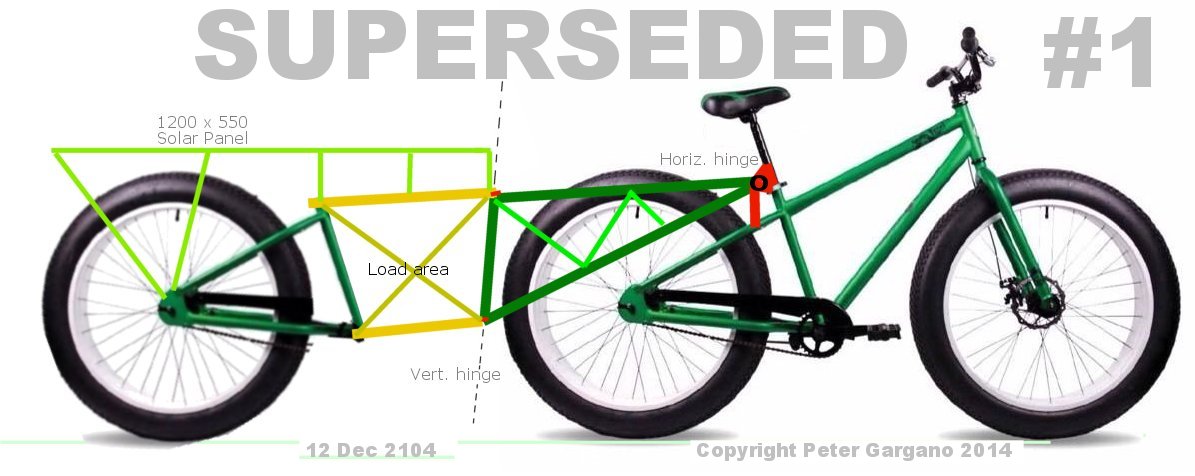
As mentioned on the main page cyclist Alan Melville, cycling from Mukinbudin (WA) found my trailer 2014 was unstable and hard to handle in the sand, and this probably contributed to him pulling out after a couple of days of what he considered intolerable corrugations. This experience demonstrated to me that a new trailer design was required to successfully negotiate the CSR by bicycle the way I wanted to do it.
this page is a work in progress ...
Details of my old (Mk #1) 2014 trailer can be seen here [coming soon], but shown here is my new 2015 design (concept iteration #2) - longer, more rigid structurally with quality roller-bearing vertical and horizontal hinges, and a true quick release system (and here's previous concept #1). Its major design feature is, right behind the saddle, a "co-planar hinge" for the integrated horizontal and vertical hinges necessary when a single wheel trailer is used (a self-supporting multi-wheel trailer can use a simple ball-joint coupling) - this is different to the BOB, and other designs, in that the vertical "hinge distance" is much longer, giving it inherent stability over shorter designs. A disadvantage of my system is it's potentially greater weight. Note that a multi-wheel trailer will not work on the CSR as, for much of its distance, the CSR is simply two U-shaped corrugations that all vehicles must use.
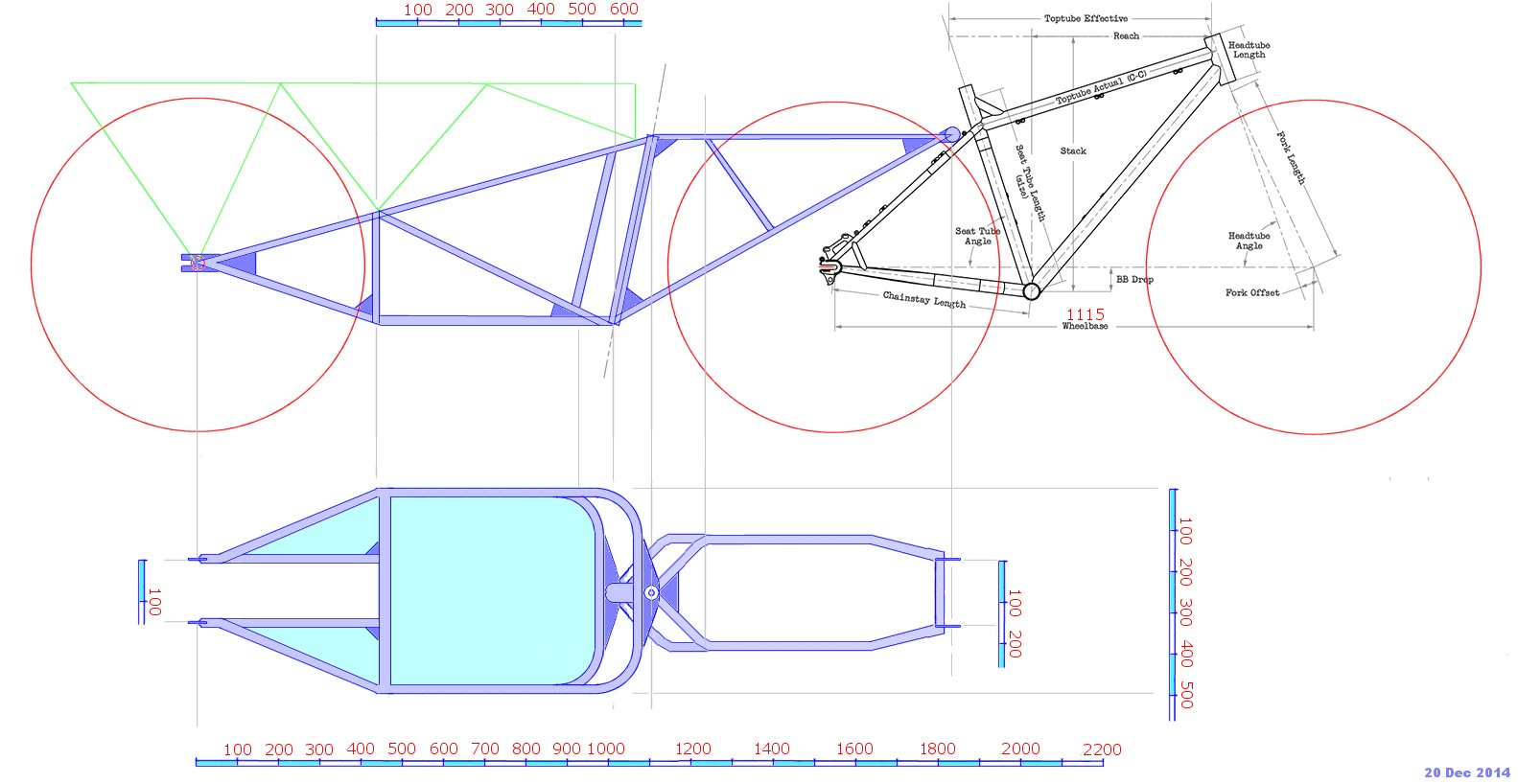
Very important is the connection point between trailer and bike - the classic BOB and ExtraWheel designs both connect to the rear axle. The major problems of this connection scheme are:
By providing a purpose built connection point away from the bike's rear tyre we also realise a rigid hinge and a true quick release system with the bike's rear panniers staying with the trailer - and in seconds the bike transforms to almost it's factory-floor weight. By using the bike's seat-post and seat-stay (where most bikes will have nipples for bike-rack connections) the load is removed from the rear axles and transmitted to the rider's seat. This should promote stability through the inertia of the rider's weight centred above the connection point.
The configuration shares the trailer's load with the bike's rear wheel, and, as the connection point is ahead of the rear axle, a very small part of the trailer load is taken by its front wheel too. The trailer is therefore steered by the rider, just a little, rather than simply being pulled and reacting to the rear wheel alone. Those big semi-trailers you've probably tried to avoid on the highway also work this way too.
page last updated xxx December 2014